

SUMMARY
- U.S. Equities: While maintaining a slightly bullish stance on U.S. equities, I prefer holding current positions rather than aggressively adding new exposure near today’s elevated market highs. To navigate potential volatility, I prefer diversifying across investment styles (growth, core, value) and balancing core large cap exposure with high-quality, profitable mid and small cap companies and dividend growth strategies.
- International Equities: I remain slightly bullish on international equities. Despite a narrower valuation discount, foreign equities remain attractive due to solid corporate fundamentals, resilient earnings growth, and longer-term bullish technical trends. I continue to prefer active management for diversified exposure across both developed and emerging markets while being mindful of concentration risk in market cap-weighted emerging market indices.
- High Income-Generating Assets: I remain moderately bullish on diversified exposure to high income-generating assets like high yield credit-sensitive bonds, dividend growth companies, and option income strategies to provide resilient cash flow and dry powder in a consolidating market. I am currently cautious on closed-end funds due to tight NAV discounts and elevated leverage risks, preferring to wait for wider discounts and more attractive valuations before increasing exposure there.
- Commodities (Gold & Oil): I view gold primarily as a trading commodity rather than an asset that provides a consistent hedge against other assets. While gold is under its 200-day moving average, I’m slightly bearish over the very short term, but as long as prices hold above the $3,900–$4,000 support level and potentially break higher past its 200-day moving average, I would be slightly bullish over the intermediate term. Meanwhile, while ongoing geopolitical tensions create near-term upside pressure for WTI crude oil near $90 per barrel, I remain bearish over the intermediate term given where prices sit within their historical range.
- Conservative Assets (Bonds): I remain moderately bullish on conservative assets including U.S. Treasuries, as higher yields around 5% offer compelling income and bond prices could benefit from potential capital appreciation if interest rates fall from current levels. I am only slightly bullish on U.S. investment grade credit due to historically tight corporate spreads, preferring diversified, active multi-sector bond managers to navigate these risks and capitalize on opportunities.
- Other (Hedges): I previously favored hedging AI-related exposure, but am now slightly less concerned as those stocks have experienced material pullbacks. I maintain a slightly bullish stance on hedged strategies with a reduced need for complex strategies. Instead of aggressive hedges, I prefer utilizing option income-generating strategies for equity protection and maintaining high credit quality with balanced duration to manage tail risk in the current environment.
The global economic and corporate environment has remained resilient since my June 8th Outlook & Positioning piece. Strong investor sentiment drove equity markets higher, propelling the S&P 500 to a record peak above 7800 in August and extending its year-to-date gains to over 13% through the end of August.
S&P 500 Index

Corporate earnings are showing robust growth this year, with S&P 500 companies projected to increase their earnings per share by more than 30% in 2026 and maintain double-digit growth in 2027. This underlying strength provides a potential floor for investors to continue to support the U.S. equity market into next year.

S&P 500 earnings growth has been largely driven by the energy, communication services, and technology sectors, with tech expected to remain the primary engine of growth into 2027.

As illustrated in the following chart, S&P 500 profit margins have been exceptionally strong, but investors often question the sustainability of these levels. Moving forward, margin resilience may depend on two key factors: the return on massive corporate AI investments and the ability of companies to maintain pricing power and pass along higher input costs to customers.

Equity Market Performance Rotation
Unlike the first half of the year, which was dominated by the artificial intelligence trade and other speculative momentum-driven stocks, we have seen a healthy rotation into other areas of the market. The massive outperformance of AI-related stocks and broader price momentum had reversed a bit. Investors are increasingly questioning when hyperscalers and semiconductor companies will deliver tangible returns on their massive AI investments. As illustrated in the following chart, this shift has led to the recent underperformance of both the technology-heavy NASDAQ 100 and the momentum factor over the last three months.

As the following chart illustrates, strength in the price momentum factor has reversed within the mid- and small-cap spaces, while quality factor indexes have continued to grind higher over the same period. Given my prior concerns that the aggressive rally in momentum-driven stocks was overextended, diversified exposure to high-quality, growing companies across market cap and geographies remains my preferred strategy.
Mid and Small Cap Momentum vs. Quality Index Performance YTD

U.S.-Iran Conflict Continues to Drive Energy Price Volatility
The ongoing conflict between the United States and Iran has triggered a significant supply shock in global energy markets, largely due to shipping disruptions in the Strait of Hormuz. Despite intermittent ceasefires, oil prices remain volatile and elevated, with WTI crude oil trading over $90 per barrel. Surging gasoline and diesel prices are heavily inflating transportation and production overhead for businesses. If these elevated energy costs persist, they will likely be passed on to consumers, keeping headline inflation stubbornly above the Federal Reserve’s target and complicating any efforts to ease monetary policy.

The U.S. Strategic Petroleum Reserve (SPR) has been drawn down to levels unseen since the 1980s. In an effort to replenish the severely depleted reserve, President Trump recently announced a strategic equity stake in a private Venezuelan oil venture, potentially providing access to a low-cost supply of crude oil. While this venture aims to bolster domestic energy security and ultimately lower global oil prices, rebuilding Venezuela’s degraded infrastructure will take time. Consumers will likely have to wait longer for any noticeable relief at the gas pump.

In the U.S., the conflict has heightened fiscal pressures and injected significant uncertainty into capital markets. Unplanned military expenditures and expanded deployments have accelerated deficit spending just as the national debt has surpassed $40 trillion. This surge in debt issuance, combined with sticky inflation, has sparked a sell-off in sovereign debt and driven Treasury yields higher, drastically increasing federal interest costs.
For investors, this creates a challenging macroeconomic backdrop. Higher oil prices threaten to entrench inflation and keep interest rates elevated. This increases borrowing costs, which can stifle corporate investment, curb consumer spending, and slow economic growth, ultimately weighing on equity, bond, commodity, and currency markets.
The Federal Reserve Navigates Inflation Pressures and Economic Stability
A moderately growing U.S. economy, persistent higher oil prices stemming from the U.S.–Iran conflict, and insatiable demand for AI infrastructure continue to drive elevated inflation numbers. In response, the Federal Reserve has tilted towards a hawkish stance, indicating its monetary policy focus is on achieving its 2% inflation target.
The Federal Reserve, led by new Fed Chair Kevin Warsh, recently held the federal funds rate steady at 3.50% to 3.75%. Consequently, investors who began the year anticipating rate cuts are now recalibrating for potential rate hikes as inflationary pressures persist alongside moderate economic growth.
According to the CME FedWatch Tool, markets are now pricing in a greater than 50% chance of the Fed raising the federal funds rate by 25 basis points (0.25%) at the upcoming FOMC meeting on September 16, and a higher probability of one more rate hike by the Fed’s December 9 meeting.


The U.S. Treasury yield curve often prices in inflation expectations well before the Federal Reserve adjusts short-term rates. As illustrated in the following chart, Treasury yields have shifted noticeably higher since the start of the year. This upward move directly increases borrowing costs for both consumers, businesses, and the government, driving up interest expenses and dampening overall spending power.

The yield on U.S. 30-year Treasuries has sustainably broken above 5%, while the 10-year Treasury yield is rapidly approaching that same threshold.
U.S. 30-Year and 10-Year Treasury Yields

Recent economic data indicate that both the broader Consumer Price Index (CPI) and the core Personal Consumption Expenditures (PCE) Index, which excludes volatile food and energy prices, remain stubbornly above the Federal Reserve’s 2% target. With July CPI at 3.4% and core PCE at 3.3%, this persistent inflation suggests investors should brace for continued market volatility as policymakers navigate upcoming interest rate decisions.
Consumer Price Index and Core Personal Consumption Expenditures

While current inflation remains a near-term challenge for the Fed, markets expect it to trend down from the current mid-3% range over time. As shown in the following chart, the 5-year, 5-year forward inflation expectation rate sits at roughly 2.3%, closely aligning with the Fed’s long-term 2% target. Because markets are pricing in a return to normalized inflation, investors broadly anticipate the Federal Reserve will eventually resume cutting the federal funds rate.
Forward Inflation Expectations

U.S. Deficit Spending and Debt Levels
Deficit spending has continued to escalate in 2026, outpacing levels seen in 2024 and 2025. Despite the ongoing economic expansion, government revenues are failing to keep pace with rising expenses, a shortfall exacerbated by the financial toll of the U.S.-Iran conflict. As the national debt climbs, the interest expense obligations compounding this deficit continue to surge, as illustrated in the following charts. If these trends persist, growing perceptions of elevated U.S. sovereign credit risk could maintain upward pressure on longer-term interest rates.

U.S. Treasury Attempting Yield Curve Management
The U.S. Treasury recently expanded its long-dated bond buyback program. The Treasury stated the expansion was intended to improve market liquidity, though many market participants view it as an effort to cap rising yields. While this intervention offered temporary technical support and briefly pulled long-term rates lower, lingering anxieties over the mounting national debt and persistent fiscal deficits quickly pushed borrowing costs back to elevated levels.
I’m skeptical that these interventions possess the necessary scale to overcome deeper structural headwinds, specifically, relentless deficit spending and a national debt that has now eclipsed $40 trillion.
Moderate U.S. Economic Growth Continues
The U.S. economy continues to exhibit solid, moderate growth. The second estimate for Q2 real GDP came in at 1.5%, reflecting a positive trajectory, though not indicative of a high-growth economic environment.

The August jobs report demonstrated economic resilience, with the U.S. adding 162,000 nonfarm jobs. While this labor data provides a solid foundation for broader economic and corporate strength, it complicates the Federal Reserve’s path. If inflation remains sticky alongside a resilient job market, the Fed will likely be compelled to maintain higher interest rates for longer.

November Midterm Elections
At the time of this commentary, recent polls indicate that the Democrats have a higher probability of gaining control of the House of Representatives, while the Republicans retain control of the Senate. Polls are just a small representation of the voting populace and sentiment can quickly change.
From both a fundamental and technical market perspective, midterm election seasons historically produce elevated equity volatility across late summer and early fall as investors digest policy uncertainty. That said, history indicates that equities frequently stage a fourth-quarter relief rally once the balance of power is determined, regardless of which party controls the chambers. A divided government scenario is often viewed constructively by financial markets because legislative gridlock limits sweeping tax revisions or drastic regulatory overhauls.
I am not making any portfolio adjustments based on current polling data, nor do I plan to shift positioning immediately post-election. Instead of trying to predict the outcomes, I prefer to let the market come to me. For most investors, a potentially more reliable strategy is to tune out campaign headlines, maintain a balanced allocation across diversified equities and high-quality fixed income, and keep long-term decisions firmly anchored to macroeconomic fundamentals and corporate earnings growth.
Looking to Next Year
As we enter the final month of the third quarter, investor attention is naturally shifting toward 2027. While 2026 has been a remarkably strong year for U.S. corporate earnings, the focus is now on forecasting the resilience of the global economy. With current projections pointing to a deceleration in earnings growth next year, we may see investors adopt a more cautious stance compared with 2026.
MY POSITIONING AND TACTICAL ADJUSTMENTS
Since my last Outlook & Positioning piece in June, I capitalized on the late June rally by completely exiting my long-held leveraged biotech position in two tranches. Having actively traded this exposure since March 2021, and with the biotech index approaching near-record highs, it was prudent for me to lock in final profits and close the trade. I reallocated the proceeds into existing positions: first, adding to an active global value equity manager, and second, increasing my exposure to leveraged Chinese equities.
In late July, as the NASDAQ 100 Index pulled back from its highs, I initiated a leveraged NASDAQ 100 position, funding the trade from a non-leveraged growth equity strategy. Days later, as semiconductor stocks also declined, I established a leveraged semiconductor position, further reducing my non-leveraged growth stocks exposure. When semiconductor stocks subsequently rallied, I capitalized on the rebound by taking some profits and rebalancing my leveraged semiconductor index position back to its target weight.
Tactically, within my Global Unconstrained investment strategy, I am maintaining leveraged exposure to the NASDAQ 100, U.S. mid-caps, semiconductors, diversified emerging markets, and Chinese equities. Overall, my aggregate leveraged exposure remains at the lower end of its historical range. Given my relatively neutral stance on current equity markets, I am cautious about materially increasing risk at these levels.
Outside of the Global Unconstrained strategy, I maintain long-term positions in Bitcoin and Ethereum. While I view both assets as highly speculative with limited fundamental anchoring, I am willing to trade them tactically. After significant drawdowns in early June, I initiated small, leveraged positions in both cryptocurrencies to capture a rebound. While that anticipated rally has materialized, I am maintaining these positions and targeting higher valuation levels before considering an exit. Given the inherent volatility of the crypto markets, I will continue to seek tactical rebalancing opportunities, taking profits on rallies and adding exposure on weakness if my target levels are reached.
Tactical Rebalancing Opportunities
While technology and cryptocurrency have experienced some volatility recently, the broader market has remained relatively quiet, offering limited tactical opportunities over the past few months. Moving forward, if volatility picks up, I plan to tactically rebalance my leveraged positions. Should we see a meaningful market pullback, I will look for opportunities to increase my overall leveraged exposure.
RISK ASSETS

I remain slightly bullish on risk assets overall.
Many global equity markets are currently trading near all-time highs and exhibiting strong technical momentum. Credit spreads in riskier fixed income sectors have also become tight. This suggests that investors are pricing in pretty strong economic and corporate scenarios. Because valuations are stretched in certain areas, I prefer not to take an overly aggressive stance right now. I would rather be patient and wait for more attractive entry points before increasing my overall risk exposure.
Within equities in the current environment, I favor broad diversification across high-quality companies with strong balance sheets and consistent earnings growth. I prefer diversification across market cap, geography, and investment styles (growth/core/value) to help mitigate potential volatility.
I continue to like exposure to multi-asset income strategies. These strategies include exposure to high-yield bonds, securitized credit, emerging market debt, option income strategies and closed-end funds. In a choppy or sideways market environment, this exposure could generate income while helping to cushion against downside risk. It also serves as “drier powder”. If shifting central bank policies or unforeseen geopolitical events cause equity markets to experience a meaningful pullback, I can readily reallocate exposure from lower volatility high income-generating assets into higher volatility equity positions at much better valuations.
The S&P 500 Volatility Index (VIX) is currently trading at the lower end of its historical range, a potential indication of investor complacency. This indicates that investors have limited concern regarding their current equity positioning. Historical trends show that market volatility can easily rise from these depressed levels. September and October are traditionally volatile months for the stock market. With the November elections approaching, the potential for market swings increases significantly. Additionally, higher oil prices driving up interest rates could act as a catalyst for equity markets to pull back from their current highs.
S&P 500 Volatility Index (VIX)

Providing a contrast to the low VIX, the CNN Fear and Greed Index is currently tilting slightly toward fear. This cautious investor sentiment could lead to a healthy consolidation period for the broader markets. Taking a brief pause right now would be technically constructive. It could establish the firm foundation needed to push equity prices higher over the coming quarters.
CNN Fear and Greed Index

From an equity valuation perspective, U.S. equity valuations have actually become more attractive since the start of the year. Valuations improved because corporate earnings growth has successfully outpaced stock price appreciation. The S&P 500 Index is currently trading at a price-to-earnings multiple of roughly 19.4x. While this valuation remains elevated compared to long-term historical averages, it is noticeably lower than recent market peaks. From a risk management perspective, these moderating valuations provide a better margin of safety for investors and is a slight net positive for my overall view on risk assets.

From a fixed income perspective, corporate credit spreads remain exceptionally tight. This means investors are demanding very little extra yield to hold riskier corporate bonds instead of safer government debt. Such narrow spreads leave limited margin of safety. If the macroeconomic environment weakens and we experience a downward shift in the credit cycle, these spreads could widen rapidly and negatively impact broader risk assets.
Interestingly, while equity markets have faced notable bouts of volatility recently, we have yet to see a corresponding panic or material widening in the credit markets. This steadiness indicates that bond investors remain confident in corporate balance sheets and the overall economy. Even with this optimistic backdrop, the current lack of additional yield makes it hard for me to justify taking excessive risks in lower-quality debt right now.

Inflation currently remains stubbornly high. Geopolitical tensions, specifically the ongoing friction between the U.S. and Iran, continue to create global uncertainty and push energy prices upward. These rising energy costs can weigh heavily on consumers and corporate profit margins at a time when broader economic growth remains only moderate.
Despite these macroeconomic headwinds, risk assets are still trading very close to their historical highs. This combination of stretched valuations and underlying fundamental risks creates multiple catalysts that could easily drive downside volatility in the financial markets. In this environment, I prefer to maintain a neutral stance on risk. I plan to patiently wait for market pullbacks to provide better entry points before taking on a heavier allocation to risk assets.
U.S. EQUITIES
I remain slightly bullish on U.S. equities.
The S&P 500 Index continues to trade very close to its all-time highs. Because of its massive size and heavy influence on financial markets, a meaningful decline in the S&P 500 would likely drag broader equity markets and other risk assets down with it. Given that prices are currently hovering at somewhat elevated valuation levels, I prefer to maintain a neutral to slightly bullish stance on U.S. equities at this time. I believe it is more prudent to hold current positioning rather than aggressively adding new exposure near the market highs.
Mid and small cap stocks have rallied significantly this year. The S&P Mid Cap 400 and S&P Small Cap 600 Indices have actually outperformed the large cap S&P 500 Index year-to-date, as of this writing. Earnings growth has supported the rally and valuations continue to support exposure to mid and small caps.

A significant portion of the small company universe consists of unprofitable companies. Many of these lower-quality stocks performed exceptionally well last year and earlier this year due to speculative momentum in the markets. Given that massive recent outperformance and my somewhat cautious stance on the broader market, I want to avoid those riskier areas. Instead, I prefer mid and small cap companies with strong balance sheets and consistent earnings growth. These higher-quality businesses could hold up better if U.S. equity markets experience a sudden pullback.
Just as I emphasize diversification across company size, I strongly advocate for diversifying across different investment styles. I certainly want to maintain my exposure to the large cap growth companies driving the massive artificial intelligence buildout. It is equally important to anchor that aggressive growth with fundamental dividend strategies and valuation-sensitive approaches.
The artificial intelligence theme has enjoyed tremendous momentum and driven broader market returns over the past couple of years. If these technology valuations become overly stretched and the current momentum begins to fade, style diversification could be important. It could provide portfolio stability if we see a broad market rotation where investors shift capital away from high-flying tech names and into lower-volatility areas of the equity market.
From a portfolio construction perspective, I prefer to use a blended investment approach. I like to start with passive exposure in the S&P 500 Index to gain broad market exposure at a very low cost. I then diversify around that core foundation by utilizing fundamentally driven quantitative strategies alongside traditional active management. When selecting active managers in both the growth and value categories, I maintain a bias toward those that focus on high-quality companies with solid earnings growth. This combination allows me to capture general market returns while selectively seeking opportunities to improve the quality, growth and valuations in different areas of the market.
From a technical perspective, we have recently seen a healthy consolidation phase across the broader markets. This brief pause has been particularly noticeable within the technology-heavy NASDAQ 100 Index and across mid and small cap stocks. Meanwhile, the S&P 500 Index continues to trade remarkably close to its recent highs. The more value-oriented Dow Jones Industrial Average has been steadily grinding higher and had remained above its 50-day moving average, but volatility is picking up in the index. These bullish technicals suggest that strong underlying investor support remains intact for now.
S&P 500 Index
The index dipped below its 50-day moving average in late July but quickly rebounded back above in August, which is bullish.

NASDAQ 100 Index
The NASDAQ 100 Index broke below its 50-day moving average in early July and traded down toward its 200-day moving average before bouncing quickly higher. The technicals remain mixed due to the index’s volatile trading around its 50-day moving average, but a rising 200-day moving average remains bullish.

Dow Jones Industrial Average Index
Unlike the S&P 500 Index and NASDAQ 100 Index, the Dow Jones Industrial Average Index had been able to stay above its 50-day moving average, but we will see if the bullish trend can continue.

S&P Mid Cap 400 Index
The S&P Mid Cap 400 Index has traded below and remains below its 50-day moving average, which is slightly bearish over the very short term, but it remains above its 200-day moving average, which is longer-term bullish.

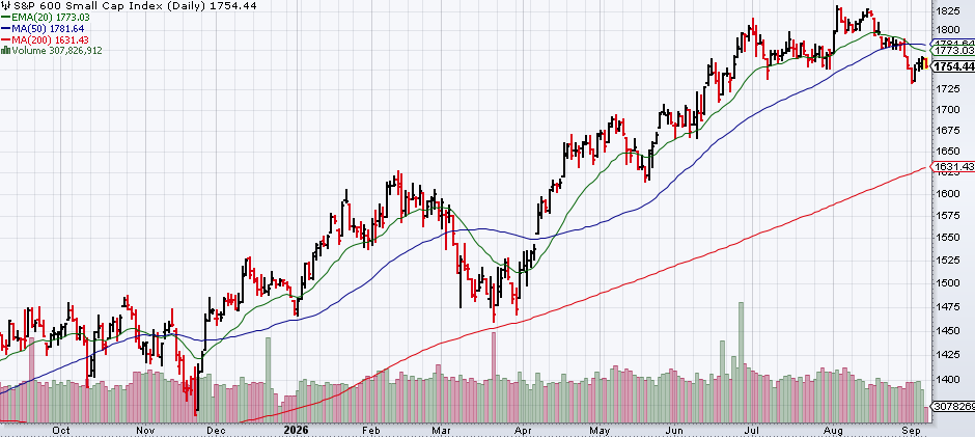
S&P Small Cap 600 Index
Similar to the Mid Cap Index, the S&P Small Cap 600 Index is trading below its 50-day moving average, which is slightly bearish over the very short term, but still above the rising 200-day moving average, which is bullish longer term.
FOREIGN EQUITIES
I remain slightly bullish on foreign equities at this time.
Non-U.S. equities have performed well this year. These international markets are currently supported by solid corporate fundamentals and continue to trade at a valuation discount to U.S. stocks.
Emerging market equities have carried their strong outperformance from last year into 2026. This momentum is largely driven by a heavy concentration of artificial intelligence companies within the MSCI Emerging Markets Index. Asian technology companies at the foundation of the global AI supply chain continue to attract massive investor support and have been a key driver of performance of the MSCI Emerging Markets Index.
While performance has been strong, it creates a vulnerability for investors relying on passive, market cap-weighted index funds. As I highlighted in my last Outlook & Positioning piece in June, the MSCI Emerging Markets Index has become heavily concentrated in just a few massive tech companies. If the global AI trade experiences a sudden pullback, passive emerging market strategies could suffer disproportionate losses. Navigating this concentration risk may require a more active management approach rather than simply holding the broad index.
As shown in the following chart, international stocks across both developed and emerging markets continue to trade at a valuation discount compared to U.S. equities. This continues to provide me comfort in having diversified exposure to foreign equities.
With that said, this valuation gap has recently narrowed. The U.S. stock market has been heavily supported by incredible strength in corporate earnings, which has driven U.S. equity valuations lower. As a result, the deep discount between U.S. and international stocks is no longer quite as wide as it was in the past.

Corporate earnings growth across international markets is anticipated to remain strong over the coming years. When you combine this healthy earnings outlook with relatively attractive valuations, it’s a strong justification for me to maintain exposure to foreign developed and emerging market equities at this time.

I continue to like diversified exposure across developed and emerging market equities, with a preference towards higher-quality, growing companies across market cap and investment styles (growth, core, value), with a preference for active management and fundamentally driven quantitative strategies. I do not favor passive, market cap-weighted index exposure for international equities.
In my tactical leveraged positioning within my Global Unconstrained strategy, I maintain leveraged exposure to diversified emerging market equities and Chinese equities.
From a technical analysis perspective, the developed market-focused MSCI EAFE Index and MSCI Emerging Markets Index remain in longer-term bullish trends.
MSCI EAFE Index (proxied by the iShares MSCI EAFE ETF)
The MSCI EAFE Index has fairly consistently traded above its 50-day moving average since April, which is bullish.

MSCI Emerging Markets Index (proxied by the iShares MSCI Emerging Markets ETF)
Similarly to the U.S. technology-heavy NASDAQ 100 Index, the Asian technology-heavy MSCI Emerging Markets Index broke below its 50-day moving average and traded close to its 200-day moving average before bouncing higher. The index currently trades above its 50-day moving average, but it has been a bit choppy at these levels.

The U.S. Dollar Index
The U.S. Dollar Index has rallied slightly this year. A stronger dollar typically acts as a drag on U.S. investors holding foreign assets because those international gains translate back into fewer dollars. Despite this currency headwind, investors have continued to allocate capital to non-U.S. equities.
The U.S. Dollar Index continues to trade in a range between 102 on the upside and 96 on the downside. We may need a material shift in interest rates or a risk-on environment for the dollar index to break out of its current tight range. I’m not anticipating a material return advantage or disadvantage from exposure to foreign currencies at this time.

HIGH INCOME

I remain moderately bullish on high income-generating assets, including high yield corporate and securitized bonds, emerging market debt, dividend growth companies, option income strategies, and closed-end funds. To gain exposure to these areas, I prefer multi-asset, tactical income strategies and broad, diversified exposure to closed-end funds.
In this environment, where equity markets have rallied strongly this year, the additional income generation from these areas could help provide returns in a flat, choppy, and consolidating equity market or provide a source of “drier powder” to use as capital to add to equities should they decline to attractive levels.
High yield corporate bond spreads are currently trading near historical lows, making it less attractive for me to take on excessive credit risk right now. Nevertheless, the appeal of high absolute yields justifies maintaining a moderately bullish stance on income-generating credit-sensitive assets.
U.S. High Yield Bond Spreads

I remain cautious on closed-end funds as discounts to net asset value remain relatively tight, and the underlying credit and equity assets within the funds are at relatively high valuations as well. Closed-end funds also often utilize leverage, which can potentially increase returns but also downside risk. In a market that could be subject to downside volatility from current elevated levels, I’m not comfortable being overly leveraged. Should broader risk assets decline to levels where valuations are more attractive, and closed-end fund discounts to NAV widen, I would be willing to increase my exposure to closed-end funds.
COMMODITIES

I remain slightly bearish on commodities at this time.
The ongoing war in Iran continues without a clear resolution in sight, keeping global market uncertainty at elevated levels. This geopolitical tension has potentially established a short-term support floor under both gold and oil prices.
If the conflict were to reach a formal resolution in the near future, we could see this uncertainty premium quickly unwind. Oil prices could face immediate downward pressure as global supply chain fears evaporate. Gold might also lose one of its bullish catalysts, potentially leading to a pullback as investors rotate capital back into riskier assets like equities.
While I monitor these technical and fundamental price drivers closely, I do not currently hold dedicated exposure to either asset. In the broader strategies I manage, I generally avoid concentrated positions in specific commodities. Commodity markets can experience sharp and unpredictable volatility driven by sudden headline news. Instead, I prefer to manage risk and pursue growth through diversified asset classes that offer long-term earnings growth potential and income generation.
Gold
As consistently mentioned in the past, I view gold primarily as a trading commodity rather than a reliable hedge against the U.S. dollar, risk assets, or inflation. Consequently, I determine its potential direction based on market technicals rather than pure fundamentals.
In my last Outlook & Positioning piece in June, I stated that gold could decline to the $3,900–$4,000 per ounce range amid technical weakness below its 200-day moving average, and that’s what happened. After bouncing from that level, gold has recovered to trade near $4,500, once again testing its 200-day moving average. A sustained break above this threshold could attract new momentum buyers and drive further gains, though I remain slightly bearish in the very short term while it trades below the 200-day moving average.
Investors typically flock to precious metals when macroeconomic and geopolitical fears rise, driving positive technical momentum. Even though gold is below its 200-day moving average, as long as gold stays above the $3900-$4000 level, I would be slightly bullish on gold over the intermediate term. If gold can sustainably break above the 200-day moving average, gold could grind higher from there.

Because gold generates neither cash flow nor dividends, its value is driven primarily by supply and demand, alongside the opportunity cost of holding yield-bearing alternatives. When the Federal Reserve raises interest rates, rising U.S. Treasury yields make government bonds more compelling. Investors seeking low-risk assets often pivot from gold to bonds to capture reliable, recurring income rather than relying strictly on price appreciation.
From a demand perspective, geopolitical tensions and global economic uncertainty frequently motivate central banks and individual investors to increase their physical gold reserves as a historic store of value. This underlying demand can support market prices even when elevated bond yields create temporary headwinds.
WTI Crude Oil
West Texas Intermediate crude oil continues to be volatile amid the announcements of ceasefires and the breaking of ceasefires in the U.S.-Iran conflict. The Middle East remains a critical region for global energy supply. Any threat of disruption naturally bids up the price of crude oil as traders price in a geopolitical risk premium.
With WTI crude oil trading above $90 per barrel, which is the upper end of its typical $60 to $90 range, I remain intermediate-term bearish, anticipating a pullback toward historical norms.
With that said, since there does not seem to be any apparent end to the conflict in Iran, and as global storage levels of oil continue to deplete, there could be continued upside pressure on oil prices in the near term. For that reason, over the very short term, I think oil prices could continue to exhibit upside pressure, but I wouldn’t take a long position at these levels due to the downside price pressures oil could eventually face.

CONSERVATIVE ASSETS
I remain moderately bullish on conservative assets as interest rates continue to grind to higher levels.
Intermediate-term investment grade corporate bonds and securitized assets, such as mortgages and asset-backed securities, currently offer attractive yields of 5% or higher depending on the specific opportunity. Compare this with an environment where equity markets are trading close to their near-term highs and large investment banks are projecting forward 10-year returns of just 6% to 8% for U.S. equities. When you consider the elevated valuation multiples in the stock market alongside ongoing geopolitical tensions and somewhat inconsistent economic growth, locking in a relatively low-risk yield of 5% or more could be an attractive strategy for both capital preservation and consistent income.
I continue to expect that inflation will eventually decline from its current elevated level. As inflation cools, the Federal Reserve gains flexibility to soften its monetary policy, which typically pushes the Treasury yield curve lower. Because bond prices and interest rates move in opposite directions, declining yields could result in a price rally for interest rate-sensitive bonds.
Fixed income can serve as a portfolio diversifier. During an equity market selloff driven by economic fears or sudden market shocks, high-quality bonds often experience a flight to safety and bonds can rally in that environment.
For these reasons, I maintain a moderately bullish outlook on conservative asset classes.
Within the realm of conservative investments, I prefer to remain up in credit quality to protect against potential corporate defaults in the event of an economic slowdown. I also prefer at least a market-weight duration relative to core bond benchmarks like the Bloomberg U.S. Aggregate Bond Index. Duration measures a bond portfolio’s sensitivity to interest rate changes, and it can help capture a bond price rally if interest rates fall as anticipated.
To gain exposure to bonds, I prefer allocating capital to diversified, multi-sector active bond managers. These investment professionals can tactically navigate across different bond sectors, adjust credit quality and duration, manage yield curve positioning, and capitalize on unique idiosyncratic credit opportunities that passive index funds simply cannot exploit.

U.S. GOVERNMENT BONDS
I remain moderately bullish on U.S. Treasuries because the Treasury yield curve remains elevated across various maturities.
My core investment thesis relies on the anticipation that overall inflation will naturally subside over the next 12 to 18 months. We are likely to see a fading of the base effects caused by recent spikes in global oil prices. The severe supply chain bottlenecks specifically related to artificial intelligence infrastructure and data center expansion could also ease in the coming years. As these temporary inflationary pressures cool down, macroeconomic conditions could stabilize. This environment gives the Federal Reserve more room to adjust its monetary policy and potentially cut interest rates next year.
As inflation drops and economic growth normalizes, I think Treasury yields could move lower from their current elevated levels, resulting in interest rate-sensitive bond prices rallying. The combination of higher current yields and future potential price appreciation sets up an attractive total return for conservative investors in U.S. government bonds.
10-Year U.S. Treasury Yield

U.S. Investment Grade Credit
I remain only slightly bullish on U.S. investment grade credit.
Corporate credit spreads currently remain at historically tight levels. The incremental yield an investor receives for taking on corporate credit risk is limited and investors are not being heavily compensated for taking on the potential risks that could arise.
In this environment, I prefer to remain broadly diversified in investment grade credit, with exposure to corporates, securitized credit (mortgage-backed and asset-backed securities), and other idiosyncratic opportunities. To get this exposure, I prefer to utilize active, multi-sector bond managers. Active fund managers have the necessary depth and breadth of research and portfolio management experience to tactically navigate the complex bond markets. They have the ability to rotate across bond sectors and adjust credit and duration exposure, depending on the market environment.
If we enter a more challenging financial market environment and credit spreads widen from current levels, I would become more bullish on investment grade credit at that time.
U.S. Corporate Bond Spreads

OTHER
I use this section to talk about other potential strategies, generally whether or not hedges are needed on asset classes.
I remain slightly bullish on hedged strategies at this time.
In my previous Outlook & Positioning piece in June, I noted that if I were to hedge anything, it would be exposure to AI-related stocks. Since then, these equities have declined materially from their peaks, some falling as much as 50%, and many have yet to recover back to their old highs. Other equities that began the year with strong speculative, upward price momentum have similarly pulled back, validating my earlier concerns.
Now that some of the froth has left the market, outright hedges in these areas may be less needed. While global equity valuations remain elevated relative to history, underlying fundamentals remain solid. Similarly, credit spreads are tight, but as long as strong fundamentals persist as expected, the credit sector could continue to perform well.
Given today’s elevated bond yields, I believe I can diversify and protect equity positions as needed using traditional assets. In this environment, I don’t have a heavy need for complex hedged equity, credit, or trend-following strategies. Instead, to reduce some equity volatility, I prefer option-income-generating strategies, which tend to be less volatile than pure equity exposure and they can produce income during choppy markets. On the credit side, I prefer to maintain high-quality bond exposure by balancing short-term credit with longer-duration Treasuries to try to mitigate some tail risk. This positioning allows me to keep duration somewhat neutral while trying to reduce credit risk through shorter maturities.
IMPORTANT DISCLOSURES
The opinions voiced in this material are for general information only and are not intended to provide or be construed as providing specific investment advice or recommendations for any individual security.
Any economic forecasts set forth in the presentation may not develop as predicted and there can be no guarantee that strategies promoted will be successful.
The terms “portfolios” or “strategies” used in this piece may be in reference to the Intrua Financial model portfolios. Any reference to performance is based on estimated, unaudited, gross of fee performance of the model portfolios. Model portfolio performance is calculated through Morningstar Direct based on model portfolio holdings. Client accounts assigned a Intrua Financial model portfolio may have positioning and performance that differs from the firm’s model portfolios at any given time.
There is no assurance that the techniques and strategies discussed are suitable for all investors or will yield positive outcomes. The purchase of certain securities may be required to affect some of the strategies. Investing in stocks includes numerous specific risks including: the fluctuation of dividend, loss of principal and potential illiquidity of the investment in a falling market.
Bonds are subject to market and interest rate risk if sold prior to maturity. Bond and bond mutual fund values and yields will decline as interest rates rise and bonds are subject to availability and change in price. Government bonds and Treasury bills are guaranteed by the U.S. government as to the timely payment of principal and interest and, if held to maturity, offer a fixed rate of return and fixed principal value. However, the value of fund shares is not guaranteed and will fluctuate.
Investing in stock includes numerous specific risks including: the fluctuation of dividend, loss of principal, and potential illiquidity of the investment in a falling market.
Asset management does not ensure a profit or protect against loss. There is no guarantee that a diversified portfolio will enhance overall returns or outperform a non-diversified portfolio. Diversification does not protect against market risk.
The fast price swings in commodities will result in significant volatility in an investor’s holdings. Commodities include increased risks, such as political, economic, and currency instability, and may not be suitable for all investors.
Precious metal investing involves greater fluctuation and the potential for losses.
Alternative investments may not be suitable for all investors and should be considered as an investment for the risk capital portion of the investor’s portfolio. The strategies employed in the management of alternative investments may accelerate the velocity of potential losses.
International investing involves special risks such as currency fluctuation and political instability and may not be suitable for all investors. These risks are often heightened for investments in emerging markets.
Intrua Financial, LLC is an SEC-registered investment adviser. Registration does not imply a certain level of skill or training.

Investment Consultant | Portfolio Manager | Wealth Advisor
Eric is a member of the Larson Financial investment committee and provides private wealth management services through Intrua Financial.
A passionate advocate for financial literacy, Eric also develops multimedia educational courses and market insights designed to demystify complex investment concepts for individual investors.
Prior to his current roles, Eric served as a Senior Portfolio Analyst and Vice President at Robert W. Baird, and previously as a Mutual Fund Specialist at U.S. Bancorp Fund Services.
He is a CFA® charterholder and a CERTIFIED FINANCIAL PLANNER™ professional. Eric earned his Master of Business Administration with a specialization in Finance from Marquette University, graduating with honors, and holds a Bachelor of Business Administration from the University of Wisconsin–Madison.